Works Cited
Bai, Nan, et al. “Classification of UNESCO World Heritage Statements of ‘Outstanding Universal Value’.” Findings of the Association for Computational Linguistics: EMNLP 2021, 2021, pp. 372–384. ACL Anthology, https://aclanthology.org/2021.findings-emnlp.34/.
Outstanding Universal Value (OUV) is the core concept that UNESCO uses to justify why a site is significant enough to receive protection as “World Heritage.” This paper is about using natural language processing (NLP) to classify UNESCO Statements of OUV according to the official selection criteria, arguing that standard single-label classification is inadequate because heritage criteria are inherently connected and often co-occur within the same site justifications. By modeling OUV in this way, the study provides a computational lens for analyzing how UNESCO formally describes cultural and natural value, which can support broader research about how types of heritage are categorized, emphasized, and globally distributed. This approach is especially useful for research questions related to power and representation, such as comparing site counts per country versus per capita, tracking how patterns of inscriptions shift over time, and identifying which regions or types of heritage have seen the greatest growth in recent history. However, because the study relies entirely on official UNESCO texts, it reproduces the same biases and silences presented in UNESCO itself, so cultures and heritage that are underrepresented in the World Heritage List remain marginalized in the model’s output.
Bertacchini, Enrico, et al. “The Politicization of UNESCO World Heritage Decision Making.” Public Choice, vol. 167, no. 1–2, 2016, pp. 95–129, https://doi.org/10.1007/s11127-016-0332-9.
This paper examines whether UNESCO World Heritage inscription is mainly driven by expert heritage evaluation or by political influence within the World Heritage Committee. Their central argument is that decision-making has become politicized: Committee outcomes often diverge from the technical recommendations of UNESCO’s advisory bodies (notably ICOMOS and IUCN), and those divergences are systematically associated with political/economic power and strategic relationships among states. Empirically, they operationalize “politicization” by measuring the gap between expert recommendations and final Committee decisions, using a dataset drawn from World Heritage Committee session summary records from 2003–2012, and they ask whether membership, delegation size, and cross-country ties help predict upgrades or favorable outcomes beyond what experts advised.
This is directly relevant to our research using UNESCO World Heritage site datasets because it shows that an “inscribed/not inscribed” spreadsheet is not merely descriptive; it encodes an institutional process shaped by power, diplomacy, and incentives (including tourism and prestige), which affects what ends up visible in the dataset at all. It also connects cleanly to other readings on UNESCO and tourism impacts: if inscription is partly political, then “heritage value” and downstream tourism/economic effects are not purely the result of objective cultural significance, but also of who is able to successfully navigate nomination politics and Committee dynamics. My critique is that the paper’s proxy for politicization, divergence from advisory bodies, is persuasive but not perfect: disagreement with experts can sometimes reflect legitimate value conflicts or broader considerations not captured in technical reviews, and “summary records” can’t fully observe behind-the-scenes bargaining. Still, as a dataset critique tool, the paper is extremely useful because it warns us not to treat the World Heritage List as a neutral map of global heritage, but as a product of contested governance.
Bertacchini, Enrico, Federico Revelli, and Roberto Zotti. “The Economic Impact of UNESCO World Heritage: Evidence from Italy.” Regional Science and Urban Economics, vol. 105, 2024, article 103996, https://doi.org/10.1016/j.regsciurbeco.2024.103996.
This research paper studies the impact on income and property values in Italian municipalities with UNESCO World Heritage (WH) sites inscribed within the past two decades. Despite the goal of UNESCO being to preserve and protect heritage sites, countries perceive the designation as helpful for marketing and place-making and leading to potential economic impact. In the study, the authors argue that UNESCO World Heritage inscription causally increases local income and raises property values, specifically for luxury housing and commercial real estate in urban areas. The work contributes to the literature in multiple ways. First, prior studies on UNESCO designation and economic impact have mixed results and often lack causal identification. This paper improves on that literature by using a quasi-experimental design, which strengthens the causal claims. Consistent with tourism-led gentrification research, the findings suggest that cultural designation attracts higher-income residents and concentrates income, reinforcing arguments that cultural branding reshapes urban social composition as well as economic outcomes. While the paper is methodologically rigorous and makes a strong casual case, there are some limitations. The study documents rising income and luxury property values but does not directly observe who loses from these changes because low-income residents, renters, and displaced populations are not measured, which limits conclusions about welfare effects and equity. Additionally, Italy’s dense cultural geography and strong tourism sector may limit the applicability of the results to countries with weaker heritage institutions or more elastic housing supply. Finally, the paper focuses on benefits but does not quantify the financial, political, or opportunity costs of pursuing UNESCO designation, which is important to determine whether such designations are socially optimal.
Brumann, Christoph. The Best We Share: Nation, Culture and World-Making in the UNESCO World Heritage Arena. Berghahn Books, 2021.
The Best We Share is Christoph Brumann’s ethnographic and political analysis of the UNESCO World Heritage Committee. In his work, Brumann contends that what is considered “Outstanding Universal Value” is more than just cultural judgment; rather, there is room for negotiation, diplomacy, and national strategic interest. Despite UNESCO’s best intentions for preservation, Brumann’s observations of UNESCO meetings indicate that negotiations for the inscription of sites are decided on the basis of compromise, alliances, and geopolitical factors.
This book is particularly relevant to our UNESCO dataset project because it assists us in understanding the data not just as a set of globally “best” sites, but as a political process. Brumann’s study actually supports our broader research question of the effect of power dynamics in the distribution of sites. Presumably, the overrepresentation of some sites in the world could be evidence of a more powerful diplomatic network rather than any issue of cultural value. In addition to this, the study is reminiscent of both Di Giovine’s concept of heritage as a global system and Woodward and Cooke’s discussion of official heritage frameworks.
One strength of Brumann’s work is his position as an “insider,” which is rather unusual and provides valuable insight into the reality of decision-making processes. Nevertheless, since the book is rather dedicated to the role of political committees, it fails to discuss the long-term socioeconomic effects of inscription. Still, it is indispensable to comprehend the political underpinnings of the World Heritage List that the data builds on.
Brumann, Christoph. “Shifting Tides of World-Making in the UNESCO World Heritage Convention: Cosmopolitanisms Colliding.” Ethnic and Racial Studies, vol. 37, no. 12, 2014, pp. 2176–2192, https://doi.org/10.1080/01419870.2014.934261.
Bruman explores how the formation and interpretation of UNESCO World Heritage Convention has been influenced by the competing understandings of the concept “world heritage”. In the article, he argues that instead of the convention being a harmonious place of different cosmopolitan ideals, it instead acts as a battle ground with lots of clashing, especially Western universalism and localized cultural particularism. Bruman comes to this based on his evaluations of the UNESCO archives, discussing policies and the transformation from initial heritage universalism to localized needs for local empowerment and cultural diversity.
This article shows relevance to our research due to its emphasis on how international policy frameworks incorporate ideological tensions that affect the value of different histories and communities. Despite Brumann’s rich analysis of the ideological development of the convention, there is an emphasis on institutional texts that fails to incorporate ethnographic sensibilities of heritage practitioners on the ground.
Dattilo, Martina, Fabio Padovano, and Yvon Rocaboy. “Soft-Power and Pro-European Bias in the UNESCO World Heritage List? A Test Based on ICOMOS Experts’ Evaluations of Colonial Sites.” Public Choice, vol. 204, no. 3, 2025, pp. 425–456, https://doi.org/10.1007/s11127-024-01248-z.
This article examines whether European “soft power,” the embedding of European aesthetic and cultural standards that subtly evaluates Western-style architecture as fitting the standard of what UNESCO considers having “outstanding universal value,” compared to Indigenous heritage sites that predate European colonization. This study specifically investigated the way sites were evaluated by the International Council on Monuments and Sites before the stage of politically lobbying. Using two criteria of measurements, the number of Outstanding Universal Value checkpoints met and a composite score derived from textual analysis of evaluation reports, it was revealed that ICOMOS experts have no systematic bias towards European heritage sites over Indigenous sites, challenging arguments that claim European soft-power favors Western ideas of heritage and rigs the selection process. They also considered variables such as site type, religious association, distance from colonial coastlines, and regional locations and concluded that there was no influence in a preference towards European-style heritage sites. The article’s main argument is that expert-level evaluations are impartial and that Europe’s disproportionate representation on the World Heritage List may be more likely caused by political negotiation, nomination capacity, and historical accumulations rather than biased criteria, which allows space for further research into other factors of designation. These findings are crucial to our research because it directly informs one of our research questions regarding uneven per-capita representation and Europe’s dominance in cultural site concentration; this article proposes that global imbalances cannot be explained by biased criteria alone. A limitation of this article is its narrow focus on the evaluation stage of the UNESCO World Heritage Designations, excluding the later committees’ processes where political negotiation and state power can strongly shape outcomes. As a result, the article explains how imbalance is not produced in one stage, but less assertively addresses where power has influence in other parts of the selection process.
Di Giovine, Michael A. The Heritage-Scape: UNESCO, World Heritage, and Tourism. Lexington Books, 2009.
In “The Heritage-Scape,” author Michael Di Giovine provides an examination of the World Heritage program by the UNESCO organization as it relates to the larger cultural system of the world as affected by tourism, globalization, and international relations. Instead of viewing such sites as strictly historical monuments, Di Giovane indicates that the inscription of such sites actually changes the location. Once they are added to the list by the UNESCO organization, they enter the “heritage-scape” and become part of the larger cultural system related to the intersection of symbols of prestige, culture, and economics.
The relationship between heritage and tourism is another focus of the book. Di Giovine states that inscription may also result in international visibility. This means that there will be income gained from international tourists, but there may also be negative effects of development. Di Giovine states that the inscription of a site may not just preserve culture but also transform how that culture is understood. In effect, UNESCO is seen as creating cultural value instead of evaluating cultural value. Heritage is seen as dynamic, circulating internationally and being shaped by international factors
This text is particularly well-suited for our project on the UNESCO dataset because it offers insight into the ways in which the list is, in fact, not simply an aggregation of culturally significant places. Thus, the dataset is not only an aggregate measure of participation within a global system in which cultural recognition, tourism, and prestige are unequally dispersed, but rather these aspects are, in fact, addressed by Di Giovine’s notion of the “heritage-scape.” Though this text does not necessarily address tourism/globalization in relation so much to committee dynamics, it is nevertheless an important text in offering us an understanding of the theoretical context in which World Heritage status does, in fact, function, particularly in terms of global culture and economic power.
Glaser-Segura, Daniel, et al. “Considerations on Becoming a World Heritage Site—A Quantitative Approach.” Amfiteatru Economic, vol. 20, no. 47, 2018, pp. 202–216, https://doi.org/10.24818/EA/2018/47/202.
This article argues that the UNESCO World Heritage list remains geographically imbalanced despite efforts to make it more equitable. Currently, WHL applications are reviewed by independent expert bodies and decided by a rotating 21-state committee that countries can apply to be a part of. The authors compiled a country-level dataset (165 countries with >1 site) and modeled the number of World Heritage sites as a function of political/institutional and socioeconomic factors, with additional indicators pulled from the World Bank. Key predictors include how many times a country served on the World Heritage Committee and how long it has been in the convention. From this, they documented persistent regional skew towards North America and Europe and away from Africa. Even after the Global Strategy in 2016 that aimed to make representation more equal by broadening the definition of World Heritage and encouraging underrepresented regions to submit stronger lists for nomination, committee decisions were still biased. This paper could explain why our maps might show regional imbalance since countries with more institutional access (committee service) tend to end up with more sites, even after representativeness reforms. It also helps answer our questions about listings per capita by showing huge regional differences with Europe/North America having far more sites per 100M people than Asia-Pacific. We can use the comparison of listing patterns before and after the Global Strategy launch as a component in our timeline. While this is a comprehensive analysis of committee decision results, it lacks details about how these results might’ve been reached exactly. By analyzing sites per country, it also somewhat overlooks regional differences within countries, especially more multinational ones.
Huang, Chia-Hao, et al. “Does World Heritage List Really Induce More Tourists? Evidence from Macau.” Tourism Management, vol. 33, no. 6, 2012, pp. 1459–1470.
This article tests the common claim that UNESCO World Heritage List inscription increases tourism, using the 2005 listing of the “Historic Centre of Macau” as a case study. The authors point out that WHL status is widely treated as a tourism marketing tool, but rigorous econometric evidence is mixed: some studies find positive effects in pooled models, but effects on individual sites often become insignificant because the WHL listing is a one-time event and doesn’t change from year to year. To test the effect, they used a “gravity-style” tourism model and built a panel dataset that tracked tourist arrivals to Macau from 19 origin regions each year from 1998 to 2009. They included a set of control variables such as origin-country characteristics like GDP per capita and population, travel frictions like distance and exchange rates, and destination-side features in Macau like hotel capacity, public order, and the number of casinos. They also include a SARS indicator for 2003, since travel patterns that year were heavily disrupted for external reasons. While they found that there was a short-run increase in tourists after the listing and that the “heritage value” was mostly experienced by Asian travellers, they ultimately concluded that WHL inscription is not a primary driver of international tourism to Macau. Considered together with the Meskell article, this could demonstrate an important pattern where countries may lobby intensely for inscription even when measurable tourism gains are limited, implying prestige and diplomacy may be stronger motives than economic returns. This article can help advance our case study research by showing that the tourism effect of a WHL inscription is not necessarily a confounding variable in our comparison of GDP and inscription rates. It also highlights the critical fact that the heritage value of a WHL site is not distributed uniformly around the world, a key point that may influence power/policy decisions. This paper provides a strong analysis of a single site’s tourism change, but it is hard to generalize this to other sites globally. Results might be different for sites in the Western hemisphere or in countries with different tourism infrastructure and agendas. Further, even if a UNESCO listing doesn’t reliably increase tourism, it may still increase “prestige” or cultural capital, which can factor into political decisions even when direct economic gains are modest.
Koufodontis, N. I., and E. Gaki. “UNESCO Urban World Heritage Sites: Tourists’ Awareness in the Era of Social Media.” Cities, vol. 127, 2022, article 103744, https://doi.org/10.1016/j.cities.2022.103744
This paper explores the interaction effects between tourists and UNESCO World Heritage Sites using an economics-based approach referred to as the UNESCO Urban WHS Analysis model. The authors frame “UNESCO awareness” as something that can be explained through both supply-side and demand-side forces: on the one hand, cities have observable attributes tied to the UNESCO designation (and the way heritage is presented/communicated), and on the other hand, tourists (and locals) differ in demographics and interests, which shapes whether they notice or care about UNESCO status. To test the model, the authors construct a global sample of 105 UNESCO World Heritage cities and pair it with a very large body of user-generated content (about 2.5 million TripAdvisor reviews), which they verify and enrich using official sources. Below is a figure displaying the model and analysis methodology:
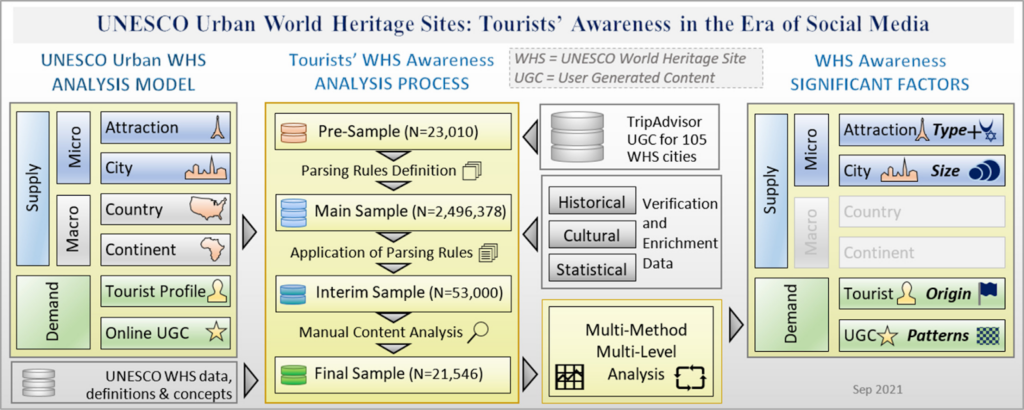
Methodologically, the study treats social media reviews as measurable signals of what people pay attention to at destinations, then statistically connects those signals to the site/city attributes and visitor profiles. Using reviews and tourist profiles, the paper applies correlational and regression-based techniques (including significance testing through reported coefficients and p-values) to identify which factors are actually associated with higher UNESCO awareness. The main takeaway is that “macro-level” attributes (broad city-level characteristics) do not explain much, while “micro-level” factors, especially features tied to tourist demographics and the way a city’s attractions are represented in social media, are much more strongly related to whether tourists and locals are aware of, or interested in, the UNESCO designation. The paper is very applicable to our data analysis, and the conclusions gathered make sense. The limitations of the paper arise from the credence given to UGC/reviews; for many people, the ways they interact with UNESCO sites are radically different. I would be curious to learn the significant factors for each individual site.
Mariani, Marcello M., and Andrea Guizzardi. “Does Designation as a UNESCO World Heritage Site Influence Tourist Evaluation of a Local Destination?” Journal of Travel Research, vol. 59, no. 1, 2020, pp. 22–36, https://doi.org/10.1177/0047287518821737.
This article is about a study examining whether the designation of UNESCO World Heritage Sites improved tourists’ evaluations of the destinations. Through analyzing 806,945 international tourists in Italy from 1997-2015 across 47 UNESCO sites, the authors discovered that UNESCO designation actually exerts a negative effect on overall tourists ratings for the area that goes into effect immediately and persists for the following five years. Uniquely, this study inspects the sentiments of tourists towards the entire province hosting the site rather than the individual monument itself to reflect the effectiveness of infrastructure accommodations for large amounts of tourists inhabiting the surrounding area. Using Cumulative Logic models revealed that this negative effect is rooted in opposing goals of Heritage Management Agencies, which is to conserve the site through deliberate protective restrictions and de-marketing, and Destination Marketing Organizations, who work to attract tourists through active promotion and initiatives to adapt infrastructure for population growth. The article argues that this creates a mismatch between the UNESCO global prestige raising tourists’ expectations and the Italian sites limiting access, restricting visiting hours, and blocking expansion and transportation to preserve sites. Additionally, DMOs have limited funding to market the designation and improve larger infrastructure and facilities, revealing that mostly high-spending tourists and those with longer stays deliver poorer ratings because they expect exclusive experiences that conversationalist agencies prohibit. Interestingly, the research uncovered that provinces containing multiple sites exhibit positive effects on tourist ratings because stakeholders already have experience on balancing preservation with tourism, allowing them to better accommodate an influx of visitors and resulting in a more positive visitor experience. The authors argue that UNESCO must acknowledge its dual proposition of protecting sites and encouraging tourism growth creates inherent conflict and that there must be emphasis placed in the investment in both priorities simultaneously. This article helps contextualize our analysis of the UNESCO World Heritage distribution by explaining why rapid site accumulation may reinforce inequality when destinations and their government agencies lack the capacity and resources to manage tourist expectations and build accommodating infrastructure. It opens up an opportunity to examine whether per-capita distribution inequalities in our dataset reflect the lack of institutional capacity and resource constraints that countries with fewer sites have. This would result in poorer management of increased visitor demand and leading to less opportunity to leverage future designations. However, the study and its findings is specific to Italian sites and relies solely on tourists ratings, rather than resident perspectives, economic impacts, or actual preservation outcomes. This limits the generalizability of the results, in which the Italian governance of heritage preservation policies in the context of tourism may not apply to other countries where UNESCO sites primarily serve as boosters for economic growth.
Meskell, Lynn, et al. “Multilateralism and UNESCO World Heritage: Decision-Making, States Parties and Political Processes.” International Journal of Heritage Studies, vol. 21, no. 5, 2015, pp. 423–440, https://doi.org/10.1080/13527258.2014.945614.
This article is about how UNESCO World Heritage decision-making has become increasingly politicized and studies the gap between expert evaluations and final decisions, shaped by state alliances and committee membership. The authors used a mixed-method approach: ethnographic observation of committee sessions (2011–2014) and interviews, alongside a quantitative dataset built from official committee records (2003–2013) to track Advisory Body recommendations versus final decisions, delegate counts, and state interventions. They found that there was a declining concordance between expert recommendations and committee decisions over the decade, suggesting expert advice is increasingly overridden. The graph below highlights some of their findings about expert-committee decision agreements:
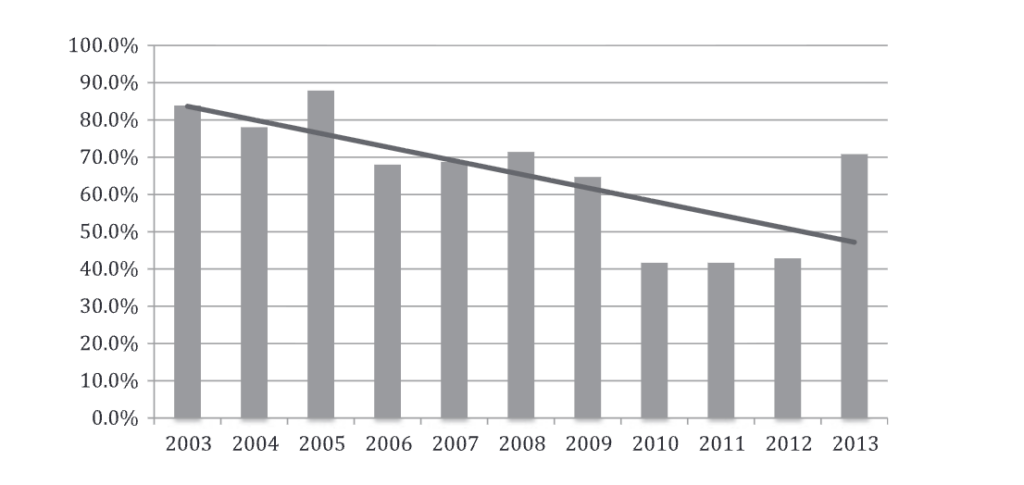
This decline is partly due to lobbying dynamics where states with large delegations to UNESCO are likely to have higher inscription rates. Countries like China, France, Brazil and Egypt are amongst some of the most vocal states. This article can help support our research along 2 facets: 1) To support our hypothesis that World Heritage inscription is prey to global power dynamics, shifting interests and inequality, and 2) To help analyze the change in inscription pattern over time to see if priorities have changed and what that reveals about the global power structure at large. While this article is strong in analyzing governance/power and offering measurable indicators, it doesn’t extend its analysis to other data like country GDP or tourism measures, which is something interesting that could be researched further.
Ryan, Chris, et al. “The Impacts of Tourism at a UNESCO Heritage Site in China—A Need for a Meta-Narrative? The Case of the Kaiping Diaolou.” Journal of Sustainable Tourism, vol. 19, no. 6, 2011, pp. 747–765, https://doi.org/10.1080/09669582.2010.544742.
This article details a study that examined residents’ attitudes toward tourism development in Kaiping, China, following its diaolou (fortified towers) becoming designated as a UNESCO World Heritage Site in 2009. The main argument of the article was that Western tourism theories and research methods cannot be directly applied to the context of Chinese tourism sites because of fundamental differences in governance structures, cultural values, and relationships to land and heritage. Through quantitative and qualitative research, made up of 57 resident interviews across four villages and a questionnaire for visitors, it was discovered that residents expressed overall pragmatic and positive opinions on the effects of the UNESCO World Heritage designation. This meant tangible improvements they’ve witnessed, such as safer roads, higher resident incomes, cleaner environments, were appreciated greater than abstract pride in cultural heritage. Residents communicated satisfaction with the amount of economic growth in the form of opportunities in tourism businesses, with many residents switching from farming to opening restaurants or selling souvenirs. Additionally, the authors explain that even within China, each heritage site produces unique sentiments and impacts based on local history, topography, and entrepreneurial capabilities that can be determined by the extent to how much area is protected heritage. This is consistent with their argument that broad generalizations in tourism impact studies are misleading. The authors propose “glocalisation,” a method of highlighting the unique, local features of tourism destinations to adapt to the increasingly globalized tourism market. This article directly relates to our research because it challenges the notion that quantitative patterns of site distribution and inscription rates cannot be interpreted through a single analytical lens. Additionally, the finding that China uses UNESCO designation as an economic development catalyst to generate increased income and employment, balancing economic prosperity with national prestige. This finding helps explain the accelerated growth of Asian World heritage sites in recent decades. Also, the glocalisation concept supports the concept that countries strategically nominate sites emphasizing unique local characteristics to stand out in a global distribution system, which may explain regional variations in the types of sites nominated. Furthermore, the article warns against treating quantitative patterns as monolithic; any disproportional distributions of sites per-capita may reflect fundamentally different cultural ideas of what heritage means and how UNESCO’s criteria for recognition may be applied across regions. Lastly, limitations in this study include the small sample size and potential selection bias of interviews, both of which largely exclude past residents who have left their city to work overseas and their unique relationship to their former land and heritage.
Tullio, Martina, and Gianluca Sampaolo. “UNESCO World Heritage Sites in China’s Cultural Diplomacy: Fostering Mutual Understanding along the Silk Roads.” Restauro Archeologico, vol. 30, no. 1, 2023, pp. 490–503, https://doi.org/10.36253/rar-14355.
This article examines how the UNESCO World Heritage Convention designation operates as a tool of cultural diplomacy and soft power for China, with an emphasis on heritage narratives tied to the Belt and Road Initiative and the Silk Road. First, the article discusses how countries like China vary their “commitment” to promoting cultural heritage based on internal priorities and global power dynamics. For example, China was able to rapidly increase its number of World Heritage List sites through eager international cooperation and cultural diplomacy in the 1980s, a period of time that also coincided with unprecedented economic growth in the country. The authors then argue that World Heritage Sites are not neutral heritage markers, but rather can strategically promote a positive national image and build international relationships (cultural diplomacy). Before the Belt and Road Initiative, China introduced the Silk Road narrative, which can be broken into three working parts: (1) revitalizing past travelers/figures, (2) promoting a “Silk Road Spirit” of openness and mutual benefit, and (3) emphasizing people-to-people bonds as the practical diplomatic tool. Specifically, China uses the Silk Roads’ World Heritage designation to advance a persuasion-based soft power narrative rather than through forced coercion. This article helps answer questions related to how UNESCO World Heritage designations can grow a country’s global influence and how power dynamics are closely entwined with these listings. It also introduces China as a good potential case study for how World Heritage recognition is related to economic and social welfare growth in the country. While this article is strong as an interpretive work, some claims need further quantitative data to back them up, such as measuring the true influence of these initiatives or the growth of the recognition of Chinese culture in other parts of the world. It could also be made concrete by discussing a few real initiatives of these programs to better convey their impact and China’s cultural diplomacy strategy as a whole.
UNESCO World Heritage Centre. “Sustainable Tourism Toolkit.” UNESCO World Heritage Centre, https://whc.unesco.org/en/sustainabletourismtoolkit/.
This source was produced by the UNESCO World Heritage Centre as an online toolkit that provides guidelines, case studies, and best practices when it comes to implementing sustainable tourism management at World Heritage sites. It discusses topics such as needing to integrate the goals of conservation with local community development and visitor experience planning. This balanced protection of cultural and natural heritage must exist for economic benefits to derive from tourism. It explains sustainable tourism as one process that involves stakeholder engagement, monitoring, carrying capacity assessment, and adaptive management strategies fitted within specific heritage contexts.
This source is relevant to our research on global heritage governance and tourism because it indicates how international institutions put into practice ideals like sustainability and community participation within policy frameworks. While the recommendations within the toolkit are broad, the content reflects the institutional priorities of UNESCO and does not extend critical examination of challenges or failures in its implementation. Therefore, it is strongest as a guideline for policy rather than an evaluative academic study.
UNESCO World Heritage Centre. “The Operational Guidelines for the Implementation of the World Heritage Convention.” UNESCO World Heritage Centre, https://whc.unesco.org/en/guidelines/.
Operational Guidelines for the Implementation of the World Heritage Convention describes the official rules and standards pertaining to the nomination, evaluation, and inscription of cultural and natural heritage sites within the framework of the UNESCO Convention for the Protection of World Cultural and Natural Heritage sites. This document provides definitions for the term “Outstanding Universal Value,” as well as the description of the various criteria for the evaluation of cultural and natural sites, namely, the ten criteria used for the evaluation of cultural and natural sites. Hence, the Operational Guidelines form a major part of the institutional framework of the World Heritage Convention and provide the rules and standards for the composition of the World Heritage List.
In terms of our project concerning the UNESCO dataset, this source is very important because it will help to illustrate the structural rules under which sites are added. It will assist us in better understanding some trends we have seen in our dataset, like the division between cultural and natural sites. This source will help us to realize how, from an official point of view, technical terms and evaluation tools affect the recognition of heritage sites at a global level. Even though, from this document, we get a sense that the process is objective and based only on procedure, there is no mention of aspects like those underlined by Brumann. As such, this source offers us a formal viewpoint, which will be useful in combination with other evaluations.
Woodward, Simon C., and Louise Cooke. World Heritage: Concepts, Management and Conservation. Routledge, 2023.
Woodward and Cooke offer a detailed examination of the ideas, policies, and administrative systems that underpin the UNESCO World Heritage program. They contend that it is not just symbolic recognition but is part of a complex pattern of international and national regulations and authorities, experts, and local stakeholders. In addition, this book will show how sites are assessed against the “Outstanding Universal Value” criterion, how these sites are subsequently monitored, and how plans for conserving them are executed. Relevant tensions between conservation, tourism, and economic growth are covered as well.
The text is useful for our UNESCO dataset project first and foremost due to its capacity to provide context about the structural logic employed in managing and running UNESCO sites. The presentation of how different criteria have emerged and how conservation policy is enforced in practice provides a context to some of the phenomena we have identified through our dataset, such as shifts in inscription patterns through time or disparities between cultural and natural sites. Although more attention is geared to different management systems, some crucial understanding regarding how UNESCO sites are formally organized and managed can be realized from the volume.